
What Makes a High-Performance Acoustic Door Achieve Rw50 to Rw63dB?
When a project requires an acoustic rating of Rw50 to Rw63dB, the door is often one of the most challenging elements to specify correctly.
Walls, floors and ceilings can all be designed to achieve exceptional sound insulation. However, if the door assembly is not engineered to the same standard, it can quickly become the weakest point in the acoustic envelope.
Achieving these high acoustic ratings requires far more than simply increasing the thickness or weight of a door. Every component of the doorset must work together as a complete acoustic system.
Material Selection Matters
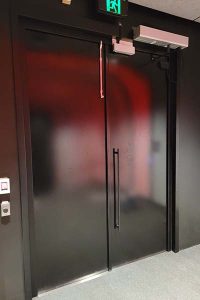
The foundation of any high-performance acoustic doorset begins with the choice of materials. The door leaf must provide sufficient mass while maintaining structural integrity and long-term durability.
For acoustic ratings in the upper performance categories, steel remains the preferred material. Its density and structural characteristics allow the doorset to achieve the levels of sound insulation required for demanding applications, including recording studios, industrial facilities, test environments and critical infrastructure projects.
Steel not only provides the mass required for effective sound insulation but also allows precise manufacturing tolerances. This enables consistent sealing performance and repeatable acoustic results across every doorset, both of which become increasingly important as performance requirements approach Rw60dB and above.
While timber doors may be suitable for lower acoustic ratings, they generally cannot provide the mass, consistency and durability required for very high levels of sound insulation without significant design compromises.
Internal Acoustic Construction
A high-performance acoustic door is defined by much more than its external appearance.
The internal construction is responsible for controlling both airborne sound transmission and structure-borne vibration. Acoustic infill materials are carefully selected to provide the optimum combination of sound absorption and the mass required to control low-frequency noise.
A key element of the design is the acoustically decoupled door leaf. The front and rear steel faces are isolated from one another to minimise the direct transmission of vibration through the leaf itself. By interrupting this vibration path, the doorset significantly reduces structure-borne sound transfer while maintaining the strength, stability and durability expected of a steel doorset.
The frame is engineered using the same principles, limiting vibration transfer between the leaf and the surrounding structure. Together, the acoustically decoupled construction, specialist acoustic infill and precision engineering enable the doorset to achieve the demanding levels of sound insulation required for professional noise control applications.
Why does this matter?
It is easy to assume that a heavier door will always deliver better acoustic performance.
In reality, weight is only one part of the equation.
The internal construction, sealing system, frame design and installation quality all contribute to the final acoustic rating. Two doors of similar weight can deliver significantly different acoustic performance depending on how they have been engineered.
 The Critical Role of Acoustic Seals
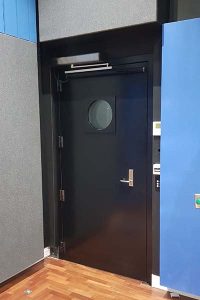
Even the most sophisticated door construction cannot achieve its design performance without effective acoustic sealing.
Small gaps around the perimeter of a door can significantly reduce overall sound insulation performance.
This is because sound will always travel through the path of least resistance. Even a minor gap can compromise the effectiveness of an otherwise high-performing acoustic barrier.
For this reason, the sealing system is one of the most important elements of the entire doorset.
IAC Acoustics acoustic doorsets utilise engineered sealing systems incorporating double or triple acoustic seal arrangements around the frame and threshold interfaces. These systems provide consistent compression and reliable sealing throughout the life of the doorset.
Cam-Lift Hinge Technology
One feature that often distinguishes high-performance acoustic doors is the use of cam-lift hinge technology.
As the door opens, the hinge mechanism raises the leaf clear of the threshold, preventing unnecessary wear and eliminating interference with the finished floor surface.
As the door closes, the leaf is lowered into position, allowing the threshold sealing system to engage consistently and achieve the compression required for optimum acoustic performance.
This design provides two important benefits:
– Consistent compression of the acoustic seals.
– A flat threshold arrangement that can support accessibility requirements.
The result is a doorset that combines high acoustic performance with practical day-to-day operation.

Designing for Compliance and Accessibility
Modern building projects require acoustic performance to be considered alongside accessibility and compliance requirements.
Flat threshold sealing arrangements can support accessibility objectives while maintaining the integrity of the acoustic barrier. This enables architects and specifiers to avoid compromising acoustic performance when designing inclusive environments.
Performance Beyond the Door
The performance of any acoustic doorset depends on more than the door itself.
The surrounding wall construction, adjacent building elements and installation details must all be designed to complement the acoustic rating of the doorset.
If the surrounding construction provides alternative paths for sound transmission, the overall performance of the space can be compromised regardless of the door specification.
For this reason, acoustic doors should always be specified as part of the complete building acoustic strategy rather than as an isolated product.
Engineering Every Detail Matters
Achieving acoustic ratings of Rw50 to Rw63dB is not the result of a single feature. It is the outcome of a fully engineered doorset in which every element works together—from the steel construction and acoustically decoupled leaf to the internal acoustic infill, sealing systems, cam-lift hinges and precision installation.
When these components are designed, manufactured and independently tested as a complete assembly, specifiers can have confidence that the installed doorset will deliver predictable, repeatable acoustic performance throughout its service life.
To see how these engineering principles translate into real building performance, read our related article.