
Why Acoustic Doors Are Critical to Building Noise Control Performance
When designing a building for noise control, significant attention is often given to wall constructions, floor systems and ceiling treatments. However, one element can have a disproportionate impact on overall acoustic performance: the door.
No matter how effective the surrounding construction may be, an incorrectly specified or poorly performing door can quickly become the weakest point in the acoustic envelope.
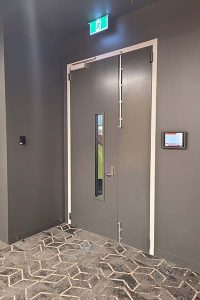
Understanding Acoustic Door Performance
All doors provide some level of sound reduction. A typical domestic external door or standard commercial door may achieve acoustic performance in the region of Rw30 to Rw35dB.
While this may be sufficient for general applications, more demanding environments require significantly higher levels of sound insulation.
Facilities such as recording studios, broadcast environments, industrial plants, laboratories, test facilities, educational spaces and performance venues often require acoustic door ratings of Rw50dB and above.
These higher levels of performance are essential where noise containment, privacy or environmental noise control form a critical part of the project requirements.
Why Small Differences in Performance Matter
Acoustic performance is measured on a logarithmic scale rather than a linear one. As a result, relatively small increases in rating represent significant improvements in sound insulation.
The difference between a standard commercial door and a high-performance acoustic doorset is therefore far greater than the numerical values alone may suggest.
This is why acoustic doors are specified and supplied as complete tested assemblies rather than individual components. The door leaf, frame, seals, hinges and threshold system all contribute to the final acoustic outcome.
Matching the Door to the Application
Different building types often require different acoustic priorities.
Some applications demand enhanced low-frequency noise control, such as music studios, theatres and entertainment venues. Others may prioritise higher-frequency performance in technical, scientific or industrial environments.
Modern acoustic doorsets can be engineered to meet these varying requirements while maintaining a consistent architectural appearance across a project.
This allows architects and designers to coordinate acoustic performance and visual design without compromise.
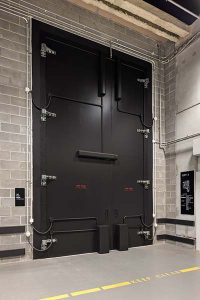
The Importance of Installation
Acoustic performance is not determined solely at the point of manufacture. Installation quality plays an equally important role.
High-performance acoustic doors are often heavy and require precise installation to ensure correct alignment, seal engagement and structural stability. Installation tolerances are typically much tighter than those associated with standard commercial doors.
Equally important is the interface between the door frame and the surrounding wall construction. Any gaps or unsealed junctions can create flanking paths that reduce overall acoustic performance.
For this reason, experienced installation teams are essential to achieving the intended acoustic outcome.
Considering the Entire Acoustic Envelope
An acoustic door should always be considered as part of a wider system.
The surrounding wall construction, room geometry, glazing systems and adjacent building elements must all be designed to work together as a complete acoustic envelope.
If any element introduces an alternative path for sound transmission, the overall performance of the space may be compromised regardless of the door specification.
A holistic design approach is therefore essential to achieving predictable and reliable acoustic outcomes.
Delivering Long-Term Acoustic Performance
High-performance acoustic doors are typically installed in environments where consistent noise control is critical.
To maintain performance over time, careful attention must be given to material durability, hardware selection, sealing systems and installation quality.To understand what drives high-performance ratings such as Rw50–Rw63dB, read our related article.
When these factors are correctly specified and implemented, acoustic doors provide long-term, stable performance within demanding environments.
Whether the requirement is to control industrial noise, protect sensitive testing environments or improve acoustic conditions in performance spaces, a correctly specified acoustic doorset plays a vital role in the success of the overall building design.